Tuesday, 7 October 2014

July 2013 - The end is nigh

The last few weeks of the 2013 field season were again mainly spent up and down the ladder, as I collected cavity parameter data from a variety of buildings and cliff faces across the study area. It was also a period of fairly intensive mapping activity, as I completed the habitat maps started earlier in the season, before heading back to the UK in mid-July.
 
Goats: scourge of Cypriot vegetation

Ayios Mammos at sunset

I did manage to grab the odd hour off here and there though, which nicely coincided with continued Odonate activity throughout the study area and few more interesting Med species.
 
Violet dropwing

Indigo dropwing

Scarlet darter

Late June 2013 - Nest boxes and turtles

With the end of the chick-rearing period upon me, it was about time to start putting up the 18 wooden roller nest boxes made for me locally earlier in the season. This was carried out with the much-appreciated assistance of my friends Christos, Emmi, Spyros and Heather; thanks guys! Hopefully the boxes will be used next spring and increase the size (and accessibility!) of the study site roller population.
 
Christos and Heather take a
well-earned break
 
An evening drink with Christos and Heather also resulted in one of the non-project highlights of the summer, when a moonlit stroll down the beach resulted in wonderful views of an egg-laying loggerhead turtle. These amazing animals breed on several Cypriot beaches, alongside the related green turtle, but are being greatly impacted by the increasing development of coastal habitats on the island.  
 
Female loggerhead turtle
(copyright C.Mammides)
 

Mid June 2013 - Fun and games with landing nets

The arrival of Dr Chris Hewson from the BTO at the start of June heralded the beginning of an intensive period of roller catching and chick processing. Or attempted roller catching anyway… One of the main lessons from the 2013 field season is that Cypriot rollers are a bugger to catch. In a two and half week period, assisted by both Chris and Dr Aldina Franco (my primary PhD supervisor at UEA), we managed to catch 11 adult rollers and deploy geolocators upon 9 of them. When the birds hopefully return to Cyprus in spring 2014 the data on the geolocators will allow us to identify the migration routes and approximate African wintering areas of the Cypriot roller population for the very first time. 
 
Chris awaits the arrival of a roller
at an Androlikou nest site
 
The main capture technique used for the adult birds was mist nets erected across the entrance of the nest cavity. When the rollers fly in to feed their chicks they are caught in the very fine netting and can then be carefully removed, before being measured and ringed. This method worked very well at most of the nest sites, but a few required a slightly more energetic input whereby a hand-held landing net was placed over the nest entrance. Suffice to say that this is an acquired skill, but both Chris and I were seasoned pro’s by the end of the trapping period.
 
My first roller!
 
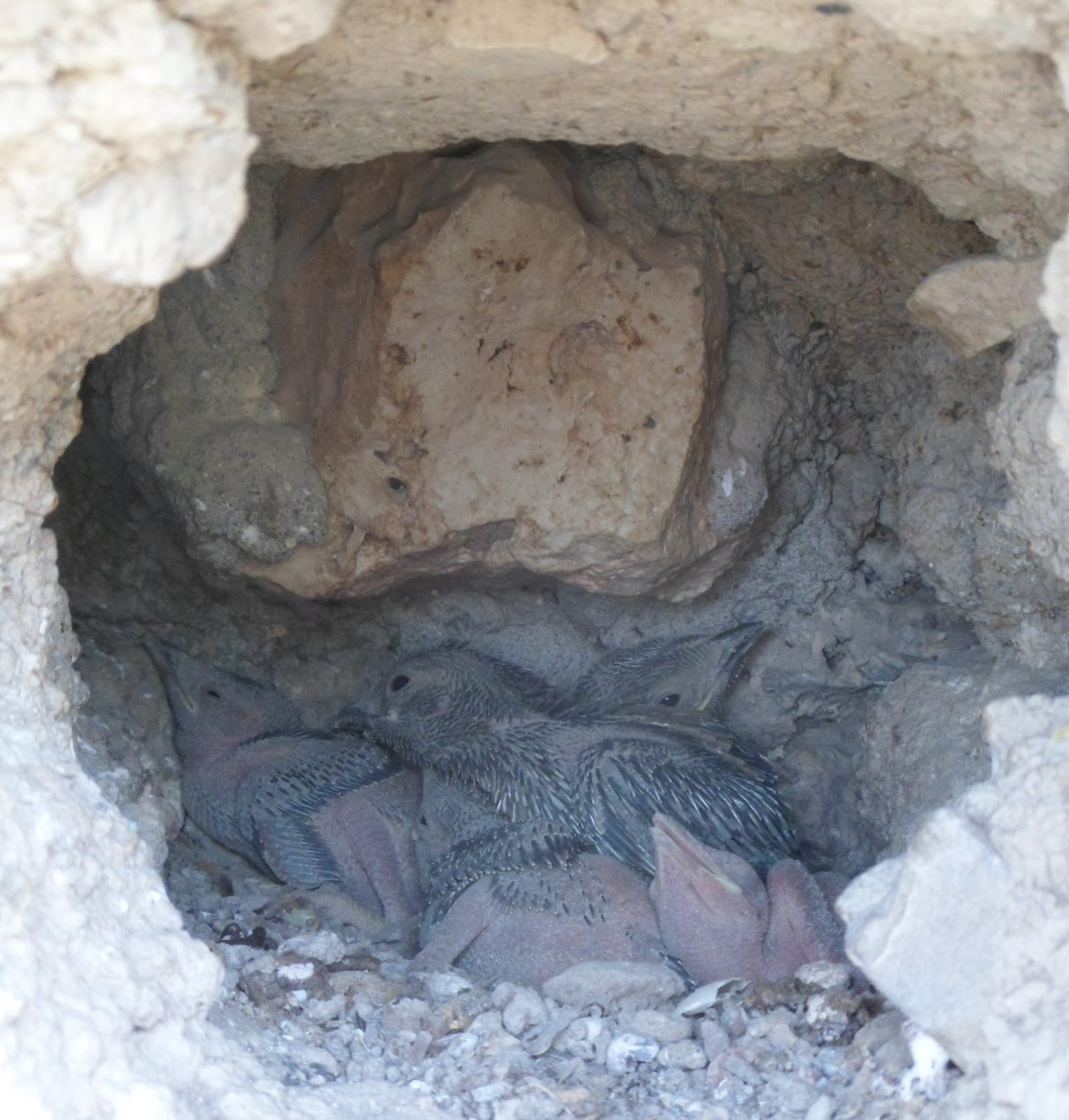
 Aside from catching and processing adult birds, June was also a very busy month due to the large number of roller chicks requiring ringing and measuring. They really are disgusting little things, which delight in soiling you with as many different bodily effluents as possible. The chicks grow very quickly, with the entire period from hatching to fledging only comprising about 3.5 weeks, so it was all go for much of the month. Several of the nests were predated during the 2013 study period too, with snakes posing one of the most likely culprits.
 
Aldina records the biometrics of an adult roller

Roller chicks; not as cute as they look...

A coin snake investigates crevices around a
roller nest site at Androlikou

Leaves on the line…

So, for those few people who regularly take a peek at this blog, you may have noticed a general absence of news over the past year or so. Apologies, but a busy winter period and a 2014 field season sans internet has made an update on the project long overdue. I’ll be updating the blog over the next few days with news from the end of the 2013 field season in Cyprus, and an overview of the work carried out this year. Normal(ish) service will resume shortly!

Sunday, 2 June 2013

The weather continues fair

Suffice to say I’ve been a busy bee since my last post. My continued quest to identify roller pairs and nest sites has paid dividends though, as I now know of approximately 40 pairs breeding within my study area! However, rollers are sneaky creatures, being very wary around the nest site, which has meant that I’ve still only managed to locate the exact nest location of maybe half of these. Luckily most of the birds have now got chicks to feed, with the majority of eggs hatching over the past ten days or so. Once the adult birds are feeding young it does make nest location a hell of a lot easier, although it also unfortunately means that for many pairs we won’t have data on laying dates or hatching success. Never mind, there’s always next year…


Not pair number 50 unfortunately

Anyone for an omelette?

Dinosaurs!

Rollers are primarily
insectivorous...

We did have some drama at one of my nests though, located in the incredibly picturesque Theletra Gorge area. About two weeks ago I found a roller egg below the nest site which had obviously been predated. Nevertheless, mum and dad continued to valiantly tend their remaining clutch until the middle of last week when their behaviour changed suddenly.  During one of my daily checks I noted both birds repeatedly swoop at the nest hole and alarm call, but refuse to enter the chamber. Unsurprisingly, on my visit next day the nest entrance was dripping with egg contents and blood and I found two eggs containing near-to-hatching chicks smashed on the ground below. All in all very distressing, but this is the nature of field biology.

The predated Theletra pair; the arrows highlight
the blood trail

Aside from the nest checks I’ve mainly been carrying out vegetation and invertebrate sampling, which has been interesting and painful in equal measure, but most especially tick-filled! A few of my sweep net and pitfall samples have also produced some interesting catches for a closet entomologist like myself with a camel spider, scorpion, and mantis all collected from various sites.
My daily rounds have also continued to produce sightings of a range of interesting wildlife, a few photos of which are provided below. The second week in May was particularly noteworthy as the island was overrun by a deluge of migrating bee-eaters. Double figure flocks were encountered calling overhead or feeding from wires at practically every site I visited, which made for a colourful few days. Sadly this episode pretty much marked the end of avian migration on the island, with the resident birds now getting down to the business of breeding.
One of the myriad of bee-eaters that
graced the island recently

One of the local pairs of Bonelli's eagles
soaring over my study area

The endemic breeding Cyprus pied wheatear
nobbling a juvenile lizard

One of Cyprus' trio of enigmatic range-restricted
Odonata; the wonderfully characterful Odalisque

Little owl and agama at Androlikou. Few of my
roller sites are without this pair of species

The endemic Paphos blue

Displaying red-rumped swallows outside my door


A black-headed bunting has a gander

Finally, a live one! A long-eared hedgehog in my
 garden one evening. They're usually identified
by their diagnostic flattened appearance

Another road casualty: a lovely adult
blunt-nosed viper

Having not had a day off in over three weeks I decided to free up a few hours yesterday morning and go for a short hike in the Avgas Gorge, which is located within spitting distance of Kritou Terra. Walking through the gorge is an amazing experience, with sheer cliffs looming overhead and only a handspan apart in places. Their walls are covered with a range of interesting plants, including the incredibly rare and range-restricted Akamas knapweed. This species’ global distribution is located entirely within the Avgas Gorge system and it is subject to one of the smallest ‘micro-nature reserves’ that I’ve ever come across! However, my main reason for walking the gorge was to look for one of the island’s charismatic dragonfly species; the magnificent emperor. This is Europe’s largest species of dragonfly and its European distribution is restricted to Cyprus and a few Greek islands. I was lucky enough to see at least four of the huge, blue, pink and black-ringed males patrolling the gorge’s central river, with one of them guarding a yellow and black female as she laid her eggs at the base of a riverside boulder!  All in all a good few hours off…


An awful photo of a fantastic insect


And the plant itself, helpfully
identified with a bit of signage

But I was soon back to work, as tomorrow I’m joined from the UK by Chris Hewson from the British Trust for Ornithology. Together we’ll be attempting to catch the adult rollers and attach geolocators and colour rings to them in the hope of tracking their migrations between Cyprus and sub-Saharan Africa this autumn and next spring.  Wish us luck!

Saturday, 11 May 2013

All go

So, I’ve now been in Cyprus for five weeks and things are moving forward nicely (even if not in the manner I’d originally planned). I’ve spent much of the past few weeks trying to locate breeding roller pairs and then mapping the broad habitats surrounding their nest sites. As you can probably imagine, this is a somewhat lengthy process (especially in the absence of any previously produced field maps) but I’m just about getting there. The habitat types out here are surprisingly diverse and it’s meant that I’ve had to curtail my somewhat grandiose planned invertebrate and vegetation sampling regime in order to leave enough time to actually watch the birds!

One of my pairs doing what rollers do best;
sitting around doing nothing!

One of my invertebrate/vegetation
sampling transects

The rollers are all nicely settled now and it looks like one or two pairs may already be laying. Many of the pairs in the study area though are still only examining nest holes so there’s probably going to be a fair spread date-wise when it comes to chicks appearing. It’ll be interesting to see if the birds become anymore territorial once the females are on eggs, as they’re already incredibly rowdy. I watched one pair this week having an aerial dogfight with a pair of hobby and another pounding on a somewhat innocuous pair of little owls that share their territory.


Play spot-the-little-owl...
 
Chez Phil is getting more and more crowded with equipment, thanks to the arrival of 10 RFID readers and various large plywood offcuts, and the fridge is half full of dead insects. Luckily my landlady has a cosy little annexe in place in case I completely run out of room. Although my sole confidante on a day-to-day basis (the eponymous Brenda) may have other ideas, as she rules the courtyard.
 
I really should move the picallily to
another shelf

The new extension

My confidante/Nemesis

Driving around my somewhat extensive study area does mean that I’m getting to see a fair bit of Paphos District and much of the really cool wildlife it supports. I’ve rescued two different chameleons from the road in the past week and the fields are full of very pretty butterfly-like Aschalaphids.  Another rather nice surprise last weekend was the sight of three (green?) turtles sculling around close offshore on a millpond sea. One thing that isn’t so nice to see is the number of dead snakes on the road. From what I’ve read, there’s a real hatred of snakes in Cypriot culture and I’m sure many of the animals are purposely run over as they bask on the road surface. Thankfully I’ve seen plenty of live ones too, so they seem to be doing okay.
 
A very skinny chameleon

They're like buses; you wait a month and then
find two in as many days

Aschalaphid

Toytle

An ex-blunt-nosed viper

As for the other birds, suffice to say that spring migration in Cyprus has to be seen to be believed. Below are a few photos of some of the more interesting sightings I’ve had lately. The red-footed falcons were part of a single flock of eighty birds(!) and there are actually fourteen pratincoles in that photo somewhere… Bee-eaters are a constant presence and the cheerful song of the black-headed bunting is now resounding around my upland study sites after their long journey back from the Indian Subcontinent.   
I'm never far from the psychopathic screeching
of the great spotted cuckoo

Male red-footed falcon
Red-foot pair
Prats

Little bittern

Red-backed shrike

Poyple heron